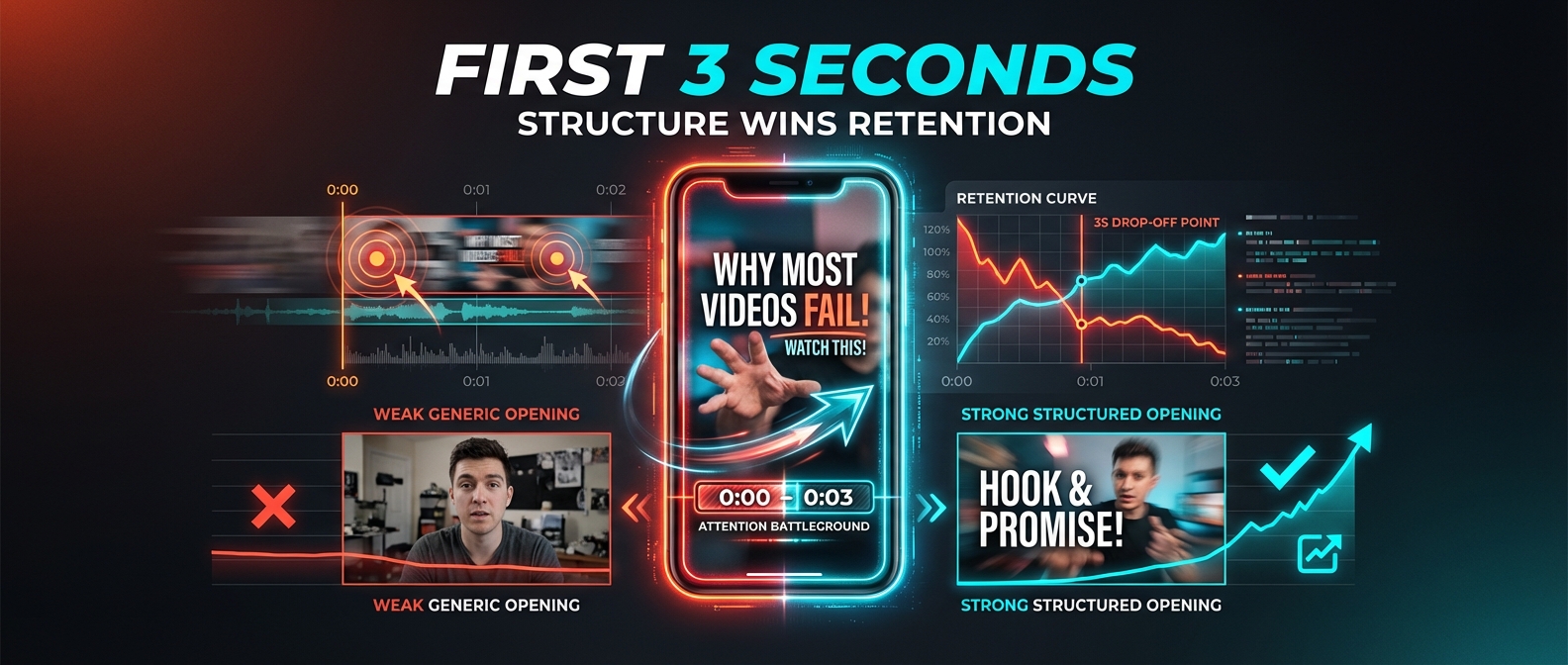
Why Most Short Videos Fail in the First 3 Seconds
When a short video underperforms, people often blame editing.
They want better transitions, better color, better captions, better sound design.
Those things matter, but they are rarely the first problem.
Most short videos lose momentum much earlier. They fail because the opening does not do enough work. In the first three seconds, the viewer should understand at least one of these things:
- Why this is different
- Why this matters
- Why they should stay
If none of that lands quickly, the rest of the video barely gets a chance.
If your team already knows the hook is weak but the production workflow is also messy, read Why Short-Video Teams Move Slowly Without Content Templates and SOPs. Weak openings and messy systems usually travel together.
The First Three Seconds Carry More Structure Than Most Teams Realize
Strong openings are not random. They are structured.
The best short-video hooks usually combine four ingredients:
1. Pattern interrupt
Something that breaks expected scrolling rhythm.
This can be:
- A sharp statement
- An unexpected visual
- A surprising claim
- A direct challenge
2. A clear promise
The viewer needs to know what they will get if they keep watching.
Examples:
- A fix
- A lesson
- A reveal
- A comparison
- A shortcut
3. Specificity
Generic hooks sound like recycled content. Specific hooks feel earned.
Compare:
- "Here are some content tips"
- "Why most teams miss deadlines even with two editors"
Specificity creates credibility fast.
4. Forward motion
The opening should create a reason to continue.
This can come from:
- Tension
- A contradiction
- A missing piece
- An unfinished claim
Without forward motion, the video feels complete too early.
For a broader tactical checklist on short-form video quality, see 5 Best Practices for Creating AI Videos.
Weak Hooks Usually Fail in Predictable Ways
Most bad openings are not bad because they are ugly. They are bad because they are vague.
Here are the most common failures.
Failure 1: Starting with context nobody asked for
Examples:
- "Hi everyone, welcome back to my channel"
- "Today I want to talk about..."
- "So basically..."
This wastes the highest-value real estate in the entire asset.
Failure 2: Leading with explanation instead of tension
People do not owe you attention. The hook has to earn it first.
Instead of opening with a full explanation, open with the problem, tension, or stakes.
Failure 3: Saying something true but unmemorable
"Consistency matters."
That is true, but it is not sticky. Compare it with:
"If your team needs a new brief for every reel, you do not have a content engine."
Now there is a sharper idea to react to.
Failure 4: Visuals and script saying different things
Even a strong opening line weakens if the screen does not support it.
If the claim is urgent but the visual is flat, the viewer feels the mismatch immediately.
A Simple Hook Framework for Short Videos
If your team needs a reliable structure, use this:
Hook formula
Pattern interrupt + problem + implied payoff
Examples:
- "Most short-video teams are not slow because editing is hard. They are slow because every brief starts from zero."
- "If your daily posting system depends on motivation, it will break the first week you get busy."
- "A lot of videos do not flop in the edit. They flop in the first sentence."
This structure works because it tells the viewer:
- something is wrong
- the explanation is coming
- the rest of the video will resolve the tension
Hook Structures by Content Type
Different content types need different opening logic.
For creator education
Good opening patterns:
- Contrarian opinion
- Operating principle
- Common mistake
Example:
Stable output is not a self-discipline problem. It is a systems problem.
For ecommerce videos
Good opening patterns:
- Pain-first
- Before/after
- Product-specific promise
Example:
If your product video needs 20 seconds to explain the benefit, you already lost the sale.
For ads
Good opening patterns:
- Objection-first
- Strong claim
- Problem agitation
Example:
Most ad teams are hiring more editors when what they really need is a repeatable creative template.
For story-led content
Good opening patterns:
- Tension-first scene
- Unresolved decision
- Emotional conflict
Example:
She only walked into the cafe to hide from the rain. She did not expect to meet the man who would ruin her week.
If you are building story-led videos around recurring characters, The Complete Guide to Character Consistency in AI Videos is the right companion piece.
Why This Matters for Reelsy Workflows
A good hook is not just a script issue. It affects the whole production chain.
In Reelsy workflows, the opening determines:
- The script angle
- The first scene or first shot
- The caption emphasis
- The pacing of the edit
- The quality of the final variation test
That is why teams get better results when they structure the hook before generating the full asset.
In Story Studio
The opening beat shapes the whole episode. A vague premise leads to a vague draft. A clear tension-led opening creates stronger first-scene direction.
In Ecommerce UGC
The AI script optimization step becomes more useful when the product brief already includes a hook style:
- mistake hook
- pain hook
- speed hook
- transformation hook
In UGC Ad
The opening is often the variable you should test first. If you want more versions, start by changing the first three seconds before rewriting the whole script.
A Review Checklist for the First 3 Seconds
Before you approve a draft, ask:
- Can the viewer tell what this video is about immediately?
- Is there a strong enough reason to keep watching?
- Does the opening line sound specific, not generic?
- Does the visual reinforce the promise?
- Would this still work with the sound off?
If the answer is "no" to two or more of these, do not move into deeper polish yet. Fix the opening first.
If your goal is not just better hooks but higher publishing consistency, pair this with Batch Content Workflows: Why Daily Posting Is a Systems Problem, Not a Discipline Problem.
One Practical Workflow Change That Improves Retention
Here is the operational shift that matters:
Do not review videos from the middle outward. Review them from the first three seconds forward.
That means:
- approve the hook structure first
- approve the first visual beat second
- approve the rest of the sequence after that
Many teams do the opposite. They tweak music, pacing, and transitions while the opening is still weak.
That is expensive polish on top of weak structure.
Final Take
Most short videos do not lose because the software is wrong. They lose because the viewer has no clear reason to stay.
The first three seconds are not a style preference. They are the compression point where promise, structure, and curiosity all have to land at once.
If your team wants better retention, stop treating the hook like a line of copy. Treat it like the structural foundation of the whole asset.
Further reading:
Next Steps
If you want to go deeper from here:
- Read Why Short-Video Teams Move Slowly Without Content Templates and SOPs if your hook problem is tied to workflow chaos.
- Read Batch Content Workflows: Why Daily Posting Is a Systems Problem, Not a Discipline Problem if your team needs a repeatable publishing system.
- Read Text to Video AI: Complete Tutorial for Creating Professional Videos in 2026 if you want to turn structured hooks into finished AI videos.
- Read The Complete Guide to Character Consistency in AI Videos if recurring characters or visual continuity matter in your format.
Want to test stronger hooks inside a faster script-to-video workflow? Start with Reelsy.