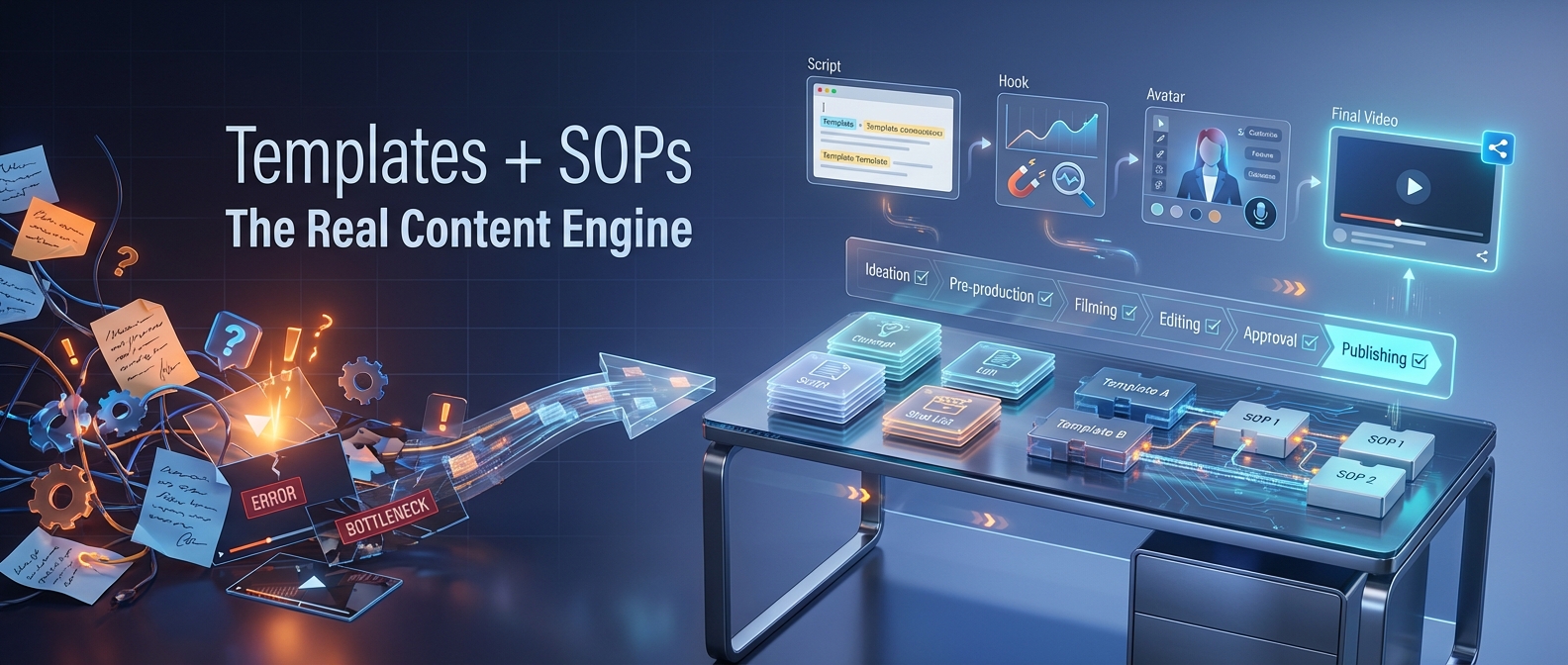
For Multi-Account Video Teams, Content Templates Matter More Than Hiring More Editors
When one account starts slipping, the first instinct is often to hire another editor.
That makes intuitive sense. More assets should require more hands.
But once a team is managing multiple accounts, more editors often make the problem worse before they make it better. Why? Because the real constraint is usually not timeline speed. It is input quality and operating consistency.
If every account runs on different rules, different briefs, different review standards, and different creative assumptions, new headcount adds output capacity without fixing the coordination problem underneath.
That is why content templates matter more than hiring more editors.
If your team is also missing deadlines because every content cycle restarts from zero, read Why Short-Video Teams Move Slowly Without Content Templates and SOPs. This article is the agency-scale version of the same problem.
Multi-Account Operations Break on Context Switching
A single-account workflow can survive with a lot of informal logic.
People know the founder voice. They know the audience. They know what "good" looks like.
The moment a team serves three, five, or ten accounts, that informal memory stops scaling.
Now the team is juggling:
- Different audiences
- Different offers
- Different tones
- Different hook styles
- Different platform mixes
- Different approval chains
If none of that is standardized, every new brief becomes a translation task.
That is where time disappears.
More Editors Do Not Fix Upstream Chaos
An editor can improve the quality of a draft. An editor cannot fix a missing operating model.
If the brief is weak, the format is undefined, and the reviewer changes expectations on every round, adding headcount mostly creates:
- More communication overhead
- More interpretation differences
- More inconsistent output
- More rework
This is why some teams with small headcount publish faster than teams with larger production benches. The smaller team often has a tighter system.
What Multi-Account Teams Actually Need to Standardize
The answer is not to standardize creativity. It is to standardize the reusable decisions around creativity.
Start with these layers:
1. Account playbook
Every account should have a one-page operating definition:
- Audience
- Core content pillars
- Primary CTA
- Acceptable tone
- Visual rules
- Approval owner
If this is missing, every asset begins with hidden assumptions.
2. Hook families
Different accounts often win with different opening logic.
Examples:
- Founder account: contrarian insights
- Product account: benefit-led hooks
- Agency account: operating mistakes
- Story account: tension-first scenes
Do not invent these live in the script every time. Document the hook families that fit each account.
If you need a stronger framework for this layer, Why Most Short Videos Fail in the First 3 Seconds breaks down the structure behind high-retention openings.
3. Format templates
Examples:
- 30-second founder lesson
- 45-second product explainer
- 60-second UGC-style ad
- episodic short-drama teaser
Each format should have a defined structure, not just a vague content goal.
4. Review criteria
If one reviewer cares about clarity, another cares about brand tone, and another cares about motion polish, the editor gets conflicting signals.
Define the approval order:
- Hook clarity
- Message structure
- Visual consistency
- Brand fit
- Final polish
This prevents expensive late-stage revisions.
Where Reelsy Helps Multi-Account Teams
Reelsy is most useful here when it becomes a standardized production layer across account types.
Story-led accounts
Use Story Studio for accounts that depend on narrative, serialized content, or repeatable episode structures. The team can standardize:
- content type
- episode framing
- aspect ratio
- story beat structure
That reduces creative reset cost between episodes and across accounts using similar storytelling logic.
If recurring characters are part of those accounts, The Complete Guide to Character Consistency in AI Videos covers the continuity problem in more depth.
Product and commerce accounts
Use Ecommerce UGC when the input is a product asset plus a selling angle. This helps teams avoid rebuilding a product-video workflow account by account.
A simple reusable template might define:
- primary buyer pain
- hook family
- product proof
- target duration
- CTA style
If your team is still deciding how to turn those briefs into full videos, Text to Video AI: Complete Tutorial for Creating Professional Videos in 2026 gives the broader production walkthrough.
Presenter-led account systems
Use AI Avatar when multiple assets need a recognizable on-screen personality without requiring repeated shoots. This matters for multi-account teams because presenter inconsistency is one of the fastest ways to lose repeatability.
Ad testing accounts
Use UGC Ad when one offer needs multiple creative angles. This is useful for teams running paid media because the goal is not to make one perfect asset. The goal is to create a structured testing set with controlled variation.
A Better Operating Model for Agencies and Studios
If your team supports multiple accounts, this is a cleaner model than "everyone just makes videos."
Layer 1: Central systems
Owned once, reused many times:
- account playbook format
- briefing template
- hook libraries
- quality checklist
- naming conventions
Layer 2: Account-specific logic
Customized per client or brand:
- content pillars
- examples
- objections
- preferred CTA
- visual references
Layer 3: Production execution
Where Reelsy workflows plug in:
- narrative generation in
Story Studio - product-led production in
Ecommerce UGC - reusable presenters in
AI Avatar - ad angle generation in
UGC Ad
This model gives the team one operating spine while preserving creative differences between accounts.
What to Centralize and What to Localize
Here is the practical rule.
Centralize
- process
- naming
- review sequence
- format definitions
- output specs
Localize
- voice
- examples
- claims
- audience language
- offer framing
If you centralize the wrong things, every account sounds the same. If you centralize nothing, delivery speed collapses.
Warning Signs Your Team Needs Templates Before More Hiring
You likely have a systems problem if:
- editors keep rewriting the hook from scratch
- revisions say "make it stronger" without clear criteria
- similar accounts still produce wildly different quality
- nobody can explain why one asset got approved and another did not
- new team members take too long to ramp
These are not talent failures. They are operating failures.
What to Measure Before You Hire
Before adding more production headcount, measure:
- average revision rounds per account
- time from brief to first draft
- on-time publishing rate
- number of reusable formats per account
- percentage of work produced from standardized briefs
If those numbers are unstable, more editors will probably increase complexity faster than output.
Final Take
As account count goes up, the leverage does not come only from production labor. It comes from reusable systems.
More editors can help once the machine is clean. But if the machine runs on vague briefs and inconsistent formats, the next hire is being asked to compensate for operating debt.
Templates solve that debt upstream. SOPs keep it solved. Reelsy works best when it sits inside that structure and turns repeatable briefs into repeatable output.
Next Steps
If you are building a repeatable multi-account content operation, this is the right reading order:
- Why Short-Video Teams Move Slowly Without Content Templates and SOPs
- Batch Content Workflows: Why Daily Posting Is a Systems Problem, Not a Discipline Problem
- Why Most Short Videos Fail in the First 3 Seconds
- Text to Video AI: Complete Tutorial for Creating Professional Videos in 2026
If your studio or agency needs a more repeatable production engine across multiple accounts, start with Reelsy and test the workflow account by account instead of trying to fix everything through editing labor alone.